Behind the crowds, robots may spend more time moving supplies, checking equipment, or cleaning spaces than greeting guests. That backstage work could change how parks run, while ride robots face stricter limits around safety, cost, and public trust.
Quick read
- Backstage robots could move food, parts, waste, and tools between work areas.
- Ride robots could inspect tracks, monitor queues, or support maintenance teams.
- Parks still need people for safety decisions, guest care, and unusual problems.
The first jobs will be away from the crowds
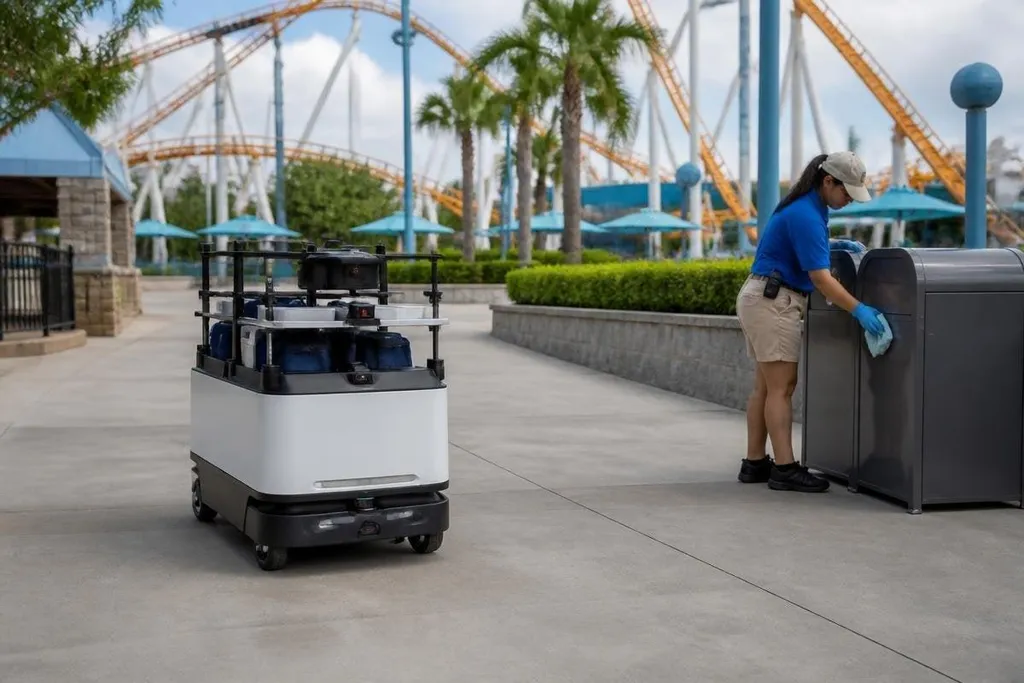
A park has long routes, fixed buildings, repeated tasks, and busy periods. Those conditions suit autonomous mobile robots, which use sensors and maps to move without a person steering every turn.
Delivery robots could carry boxes from a storage room to a restaurant. Another could move replacement parts to a ride team. The gain comes from removing routine trips, so staff can spend more time on work that needs judgment or direct contact with guests.
Cleaning offers a similar use. A robot can follow set paths across floors or outdoor walkways, then return to a charging point. It still needs a person to empty waste, check blocked areas, and deal with spills that do not fit its map.
The machine does not need to look like a character to matter. A low platform with a cargo box may be more useful than a humanoid robot if its job is moving supplies.
Rides need machines that can prove what they did
Ride maintenance is a harder task because a missed fault can put people at risk. Inspection robots might check bolts, welds, track surfaces, or moving parts with cameras and other sensors.
The useful record would include where the robot looked, what it measured, and when the check happened. That gives a maintenance team a repeatable record instead of relying on a quick visual pass from a worker walking through a large ride area.
The same system could watch for changes between inspections.
For example, a camera system might compare a part with earlier images and flag a new crack or loose panel for a person to check. The robot would point to a possible problem; a qualified worker would decide what happens next.
That split matters. A sensor can spot a pattern, but it cannot carry the legal and safety judgment for a ride opening. Parks would need clear rules for human review, shutdowns, repairs, and records.
A guest-facing robot changes the safety test once visitors can approach it. Robot24.com amusement-park robotics reports can show how staff supervised a trial and how the robot behaved when visitors moved close.
Guest-facing robots need a clear job
Guest-facing robots may welcome visitors or give directions at a large park, especially where visitors speak different languages. They could answer fixed questions, point toward a ride, or send a request to a staff member.
The limits appear when a guest asks something outside its script. A child who is lost, a visitor with a medical need, or a rider upset about a delay needs a person who can understand the situation and act on it.
Queue systems could also give wait updates, explain ride rules, or alert staff when a line becomes unsafe. The system would need to respect privacy and avoid recording more information than the park needs.
The best guest-facing design may be quiet. People visit parks for rides, food, shows, and time with friends. A robot that helps without blocking paths or demanding attention has a better chance of earning a place.
What parks should check first
Before a park buys a robot, its operations team should ask:
- Name the task: Can the job be written as a repeatable route or inspection?
- Set the handoff: Which worker takes over when the robot finds a fault or gets stuck?
- Measure the gain: Count trips, minutes, errors, or inspection gaps before the trial begins.
- Check the site: Test ramps, crowds, weather, floor changes, doors, and charging points.
- Plan for failure: Keep a manual process ready when sensors, networks, or motors stop working.
- Price the whole system: Include charging, software, repairs, training, and staff time.
I'd start with backstage transport or floor cleaning, where a robot can work in a marked area and staff can check its results. Public interaction should come later, after the park has shown that the machine works during busy days and unusual events.
The open question is not whether a robot can move through a park. It is whether the park can prove that the machine makes one job safer, cheaper, or easier to check without creating a new problem beside it.